


What the Science Says About Perimenopause
Perimenopause can make fitness feel strangely inconsistent. A workout that felt easy last month may feel heavy this week. A training plan that once seemed obvious may suddenly feel hard to choose. Motivation may rise and fall without a clear pattern. Sleep changes, hot flashes, cycle shifts, joint aches, and mood changes can all feed into the same question: “Can I trust my body and my judgment right now?”
The short answer from science is yes, but with context.
Perimenopause does not erase good decision making. It does not mean fitness progress has to stall. Research does suggest that the menopause transition can affect sleep, mood, body composition, cardiovascular risk markers, cognition, and recovery. Those changes can influence how a person weighs effort, risk, reward, consistency, and long-term goals.
This article reviews what the evidence says about perimenopause, decision making, and fitness. It focuses on practical interpretation, not fear. The goal is to understand why training decisions may feel different during this stage and how to make those decisions with better data.
***Disclaimer***This content is informational and is not a substitute for medical care. Anyone with severe symptoms, new chest pain, heavy bleeding, major mood changes, dizziness, fainting, or unexplained changes in exercise tolerance should seek care from a qualified clinician.***

Perimenopause is a transition, not a single hormone level
Perimenopause is the years-long transition leading up to menopause. Menopause is defined after 12 consecutive months without a menstrual period, when no other medical cause explains the change. Perimenopause can start years before that point.
The Stages of Reproductive Aging Workshop, often called STRAW+10, describes reproductive aging as a set of stages based on menstrual cycle patterns and hormonal changes. In everyday terms, early perimenopause often involves changes in cycle length. Later perimenopause often brings skipped periods and longer gaps between bleeding.
The key point is that perimenopause is marked by hormone variability, not a smooth decline.
Estradiol, the main form of estrogen during reproductive years, can swing high, low, and unpredictable. Progesterone may fall when ovulation becomes less regular. Follicle-stimulating hormone often rises, but it also varies. This means a single blood test may not capture the lived experience of symptoms or training readiness.
These hormonal shifts matter because estrogen and progesterone receptors exist throughout the body, including in the brain, muscles, blood vessels, bones, and connective tissue. That does not mean every symptom comes from hormones alone. Sleep, stress, nutrition, prior training history, medications, illness, and life load also matter. Still, the biology of perimenopause gives a plausible pathway for changes that affect fitness decisions.
Common symptoms during the menopause transition include:
Irregular periods
Hot flashes and night sweats
Sleep disruption
Mood changes
Brain fog or word-finding difficulty
Changes in body composition
Joint or muscle aches
Migraine changes in some people
Changes in libido or genitourinary symptoms
Not everyone experiences all of these. Some people move through perimenopause with mild symptoms. Others have symptoms that interfere with work, training, family life, and recovery.
For fitness planning, the most relevant issue is not whether symptoms exist. It is whether they change the information a person uses to make choices.
Decision making is not just willpower
Good fitness decisions rely on several brain functions working together. These include attention, working memory, emotional regulation, planning, risk assessment, and reward processing. Scientists often place many of these skills under the broad term executive function.
A training decision may look simple on the surface:
“Should I lift heavy today?”
Underneath, the brain is processing several questions at once.
How sore am I?
Did I sleep enough?
Is this fatigue normal or unusual?
Am I avoiding discomfort, or am I preventing injury?
Will training help my mood today?
Am I choosing based on my long-term goal or today’s frustration?
Do I need intensity, movement, rest, food, or medical advice?
Perimenopause can influence this process through several routes.
Sleep changes can affect judgment
Sleep disruption is one of the clearest pathways. Night sweats, insomnia, early waking, anxiety, and temperature changes can reduce sleep quality. Poor sleep affects attention, reaction time, emotional control, pain sensitivity, appetite regulation, and perceived effort.
A poorly slept brain is more likely to choose immediate relief over long-term benefit. That may look like skipping movement altogether, chasing an intense workout to “make up for it,” or changing the plan repeatedly.
This is not a character flaw. It is a predictable effect of fatigue.
Research across sleep science shows that sleep loss can impair decision making, especially when choices involve risk, delayed reward, or emotional stress. In fitness, that matters because training always includes tradeoffs. Push too hard after poor recovery and injury risk may rise. Back off too often and fitness may decline. The decision gets harder when the body’s signals feel noisy.
Mood symptoms can change perceived effort
The menopause transition is associated with a higher risk of depressive symptoms in some people, especially those with prior depression, high stress, poor sleep, or significant vasomotor symptoms. Anxiety may also rise for some.
Mood affects exercise decisions in both directions. Exercise can improve mood, but mood symptoms can make starting exercise much harder. Low mood can make a manageable workout feel pointless. Anxiety can make normal heart rate increases feel threatening. Irritability can reduce patience with slower progress.
Perceived effort is also sensitive to emotional state. The same treadmill pace can feel reasonable on one day and punishing on another, even if the external workload is identical.
Cognitive symptoms are real, but usually not global decline
Many people report brain fog during perimenopause. Common complaints include trouble finding words, forgetting why they entered a room, losing focus, and feeling less mentally sharp.
Large cohort studies, including research from the Study of Women’s Health Across the Nation, have found that some aspects of memory and processing may be affected during the menopause transition. The pattern is not the same as dementia. For many, changes appear subtle and may be temporary. Sleep, hot flashes, mood, stress, and health status can all contribute.
The fitness link is practical. If planning feels harder, a complex training program may become harder to follow. If attention is poor, technique can suffer during heavy or fast movements. If memory feels unreliable, tracking workouts becomes more useful.
A person does not need perfect mental clarity to train well. They may need fewer decisions, clearer rules, and better recovery cues.

What research suggests about fitness during perimenopause
Fitness during perimenopause sits at the intersection of aging, hormonal change, training history, and lifestyle. It is easy to blame every change on hormones. It is also easy to ignore hormones entirely. The science supports a middle position.
Body composition may shift even without major weight change
Many people notice more abdominal fat or a change in shape during midlife. Research suggests that the menopause transition is associated with increases in fat mass and central fat distribution, while aging itself contributes to loss of lean mass over time.
This distinction matters. Menopause may influence where fat is stored, while aging, inactivity, protein intake, and training load all affect muscle mass. The practical answer is not panic dieting. It is resistance training, adequate protein, enough total energy to support training, and attention to cardiometabolic health markers.
Scale weight alone is a weak guide during this stage. Waist measurement, strength trends, blood pressure, blood lipids, glucose markers, energy, and function can provide better context.
Muscle can still adapt to training
One common myth says strength gains become unrealistic after perimenopause. The evidence does not support that.
Muscle remains trainable across midlife and older adulthood. Resistance training can improve strength, muscle quality, bone loading, insulin sensitivity, balance, and function. Adaptation may require more attention to recovery, progressive loading, protein intake, and consistency, but the capacity to gain strength does not disappear.
The best-supported approach includes:
Regular resistance training
Progressive overload over time
Enough protein across the day
Sufficient calories for the goal
Recovery days
Sleep support
Technique quality
Training adjusted for pain, injury history, and readiness
Heavy training is not automatically unsafe. Light training is not automatically ineffective. The right load is the one that matches skill, health status, recovery, and goals.
Aerobic fitness remains highly protective
Cardiorespiratory fitness is strongly linked with lower risk of chronic disease and mortality across adults. During midlife, aerobic training also supports blood pressure, insulin sensitivity, mood, sleep, and energy regulation.
Perimenopause may bring changes in perceived exertion. Heat intolerance, night sweats, poor sleep, heavier bleeding, and stress can make endurance workouts feel harder. That does not mean aerobic fitness is declining overnight. It may mean the body is managing multiple stressors at once.
A mix of moderate-intensity aerobic work, interval training when appropriate, and daily movement is usually more sustainable than relying only on high-intensity sessions.
Bone health becomes a higher priority
Estrogen plays an important role in bone remodeling. Bone loss tends to accelerate around the menopause transition and after menopause. This makes strength training, impact loading when appropriate, vitamin D status, calcium intake, and medical screening more relevant.
Not everyone should jump into high-impact exercise. Prior fractures, osteoporosis, joint issues, pelvic floor symptoms, balance problems, and pain all affect exercise choice. Still, bones need load. A well-designed program may include resistance training, loaded carries, step-ups, jumps or hops for those who tolerate them, and balance work.
How perimenopause changes the decision environment
The phrase Perimenopause and Decision Making in Fitness What the Science Says sounds academic, but the day-to-day issue is simple. Perimenopause can change the inputs that guide training decisions.
Those inputs include sleep, symptoms, cycle timing, soreness, mood, body temperature, heart rate, motivation, and confidence. When those signals become less predictable, decisions require a better system.
Fitness decision | Why it may feel harder in perimenopause | A more evidence-aligned response |
Whether to train hard | Sleep and recovery may vary more | Use readiness signs, not guilt |
Whether to change the plan | Symptoms can create short-term frustration | Change based on trends, not one bad day |
Whether to diet | Body composition may shift | Protect muscle and avoid aggressive restriction |
Whether to lift heavy | Joint aches or fatigue may raise concern | Adjust load and volume while keeping strength work |
Whether to do intervals | Heat and sleep problems may affect tolerance | Use intervals selectively and recover fully |
Whether progress is still possible | Results may feel slower or less linear | Track strength, function, and health markers |
The goal is to separate signal from noise.
A single bad workout is noise. A month of declining performance, poor sleep, and unusual fatigue is a signal. One week of higher appetite may be noise. Persistent under-fueling, low mood, poor recovery, and loss of menstrual regularity before menopause may be a signal.
The brain uses energy, and fitness decisions get worse when fuel is low
Midlife fitness advice often focuses on eating less. That advice can backfire when training, sleep, stress, and recovery are already strained.
The brain relies on steady energy availability. So do muscles, bones, the endocrine system, and immune function. Chronic under-fueling can increase fatigue, reduce training quality, worsen mood, impair recovery, and raise injury risk. In active people, low energy availability can occur even when body weight appears stable.
During perimenopause, aggressive dieting can make decision making harder. Hunger, poor sleep, and irritability reduce patience and increase all-or-nothing thinking. A person may swing between strict control and exhaustion.
A more useful approach is to match nutrition to the training goal.
Protein supports muscle and appetite regulation
Protein needs often become more important with age because muscle protein synthesis may become less responsive than in younger adulthood. Resistance training improves that response. Many sports nutrition experts recommend spreading protein across meals rather than saving most of it for dinner.
Useful protein sources include:
Eggs
Greek yogurt
Cottage cheese
Fish
Poultry
Lean meats
Tofu
Tempeh
Beans and lentils
Protein powders when whole foods are not practical
Exact needs vary, especially with kidney disease or other medical conditions, so clinical guidance may be needed.
Carbohydrates support training and cognition
Carbohydrates are often treated as optional in midlife fitness plans. For active people, they can be a key part of performance. Carbohydrates support higher-intensity training, help replenish glycogen, and may reduce perceived effort during demanding sessions.
Low-carbohydrate approaches can work for some people, but they are not automatically better for perimenopause. If training quality, mood, sleep, or decision making worsens, carbohydrate timing and total energy intake deserve a closer look.
Hydration and electrolytes matter when hot flashes are present
Night sweats and hot flashes can affect comfort and perceived exertion. Hydration will not “cure” vasomotor symptoms, but poor hydration can worsen headaches, fatigue, and exercise tolerance.
For long, hot, or sweaty workouts, electrolytes may help maintain performance. People with blood pressure concerns, kidney disease, or medication interactions should ask a clinician before using high-sodium products.
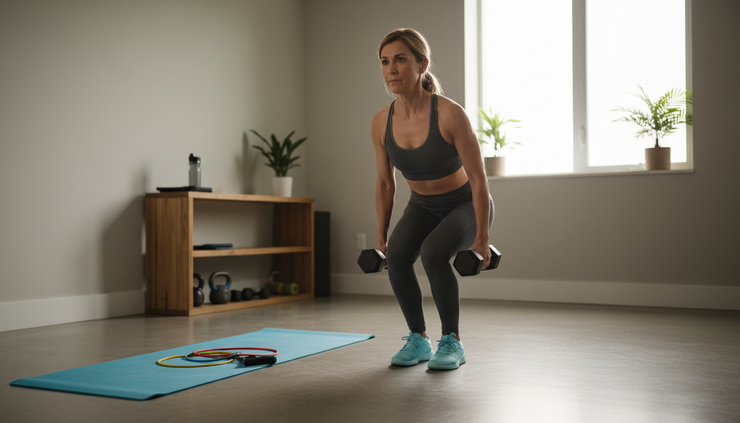
A science-based framework for fitness decisions in perimenopause
A good decision framework reduces the number of choices that need to be made in the moment. This matters because symptoms, stress, and sleep loss make spontaneous decisions less reliable.
The framework below uses three levels: stable plan, daily adjustment, and medical checkpoint.
Build a stable weekly plan
A stable plan gives the body repeated signals. It also makes progress easier to measure.
A balanced week might include:
Two to four resistance training sessions
Two to four aerobic sessions
Daily low-intensity movement
Mobility or balance work
One to two lower-load recovery days
Planned sleep and nutrition support
This does not mean every week must look the same. It means the plan has anchors. For example, resistance training might happen every Monday and Thursday, while aerobic work moves around symptoms and schedule.
Use a readiness check before changing intensity
Daily readiness does not require expensive technology. Wearable data can help, but subjective measures are also useful.
Before a demanding workout, check:
Sleep quality
Unusual fatigue
Muscle soreness
Mood and focus
Joint pain
Hot flashes or night sweats
Resting heart rate if tracked
Recent illness
Nutrition and hydration
Motivation after warming up
The warm-up is especially helpful. Many people feel sluggish before exercise but improve after 10 minutes. If movement quality improves and effort feels normal, training may proceed. If coordination feels off, pain increases, or effort feels unusually high, adjust.
Choose from three workout options
Instead of deciding between “do the plan” and “quit,” use three versions.
Green day
Energy is steady, sleep was adequate, pain is low, and warm-up feels good. Do the planned session.
Yellow day
Sleep was poor, symptoms are present, or motivation is low, but movement feels safe. Reduce volume, load, speed, or complexity. Keep the habit.
Red day
Pain is sharp, illness is present, dizziness occurs, bleeding is unusually heavy, or fatigue feels abnormal. Skip hard training and use rest, gentle movement, or medical guidance.
This approach protects consistency. It also reduces emotional decision making. The plan does not depend on being perfectly motivated.
Track trends, not moods
A training log does not need to be complicated. The most useful notes are often simple.
Track:
Exercise, sets, reps, distance, or time
Rate of perceived exertion
Sleep quality
Hot flashes or night sweats
Mood
Joint pain
Cycle changes if still bleeding
Nutrition notes when relevant
After several weeks, patterns may appear. Heavy lifting might feel best after two nights of good sleep. Intervals might worsen symptoms when done too late in the evening. Strength may hold steady even when scale weight rises. These observations support better choices.
Hormone therapy, symptoms, and training choices
Menopausal hormone therapy can reduce hot flashes, night sweats, and genitourinary symptoms for many people. It may also improve sleep when symptoms disrupt sleep. It is not prescribed as a fitness supplement, and it is not appropriate for everyone.
Guidelines from groups such as The Menopause Society emphasize individualized decision making based on age, time since menopause, symptoms, personal risk factors, and treatment goals.
From a fitness decision standpoint, symptom treatment can matter because untreated symptoms can reduce sleep, recovery, and consistency. If night sweats are causing chronic sleep loss, better symptom control may indirectly improve training decisions.
Nonhormonal options may also help some people. These include certain medications, cognitive behavioral therapy for insomnia, lifestyle changes, and environmental cooling strategies. The best option depends on medical history and symptom severity.
The key point is simple: severe symptoms are not something to “tough out” for the sake of discipline. Treating symptoms can be part of a serious fitness plan.
What the science does not yet know
Research on perimenopause and exercise has grown, but important gaps remain.
Many exercise studies historically focused on men or did not analyze menopausal stage carefully. Some menopause studies rely on self-reported symptoms. Hormone levels change daily and across cycles, so measurement is difficult. People also enter perimenopause with different training histories, health conditions, jobs, caregiving loads, and stress levels.
For decision making specifically, the evidence is indirect. We have research on menopause symptoms, cognition, sleep, mood, exercise physiology, and health outcomes. We have less research that directly tests how perimenopause changes real-time fitness choices.
That means strong claims should be treated with caution. Science supports the idea that perimenopause can affect the factors behind fitness decisions. It does not support blanket rules such as:
No high-intensity training after 45
Cardio causes menopause weight gain
Heavy lifting is dangerous during perimenopause
Hormones make progress impossible
Brain fog means cognitive decline is inevitable
Everyone needs the same menu or supplement plan
Better guidance starts with the individual pattern.
Practical training principles supported by the evidence
The best fitness plan during perimenopause is not extreme. It is structured, flexible, and honest about recovery.
Keep resistance training central
Strength training supports muscle, bone, glucose control, joint function, and independence. It also provides measurable feedback at a time when body weight may feel frustrating.
A strong program includes major movement patterns:
Squat or sit-to-stand pattern
Hip hinge
Push
Pull
Carry
Step-up or lunge pattern if tolerated
Core stability
Balance work
Progress can come from more load, more reps, slower tempo, better range of motion, improved control, or less pain.
Use cardio for health, not punishment
Aerobic exercise supports heart health, brain health, metabolic health, and mood. It should not be used only to burn calories.
A practical mix includes easy-to-moderate sessions plus occasional harder work if recovery allows. Walking, cycling, swimming, rowing, hiking, dancing, and incline treadmill work can all count.
Respect recovery without becoming inactive
Recovery does not always mean complete rest. Gentle movement can improve stiffness, mood, and circulation. The right recovery choice depends on the problem.
If the issue is poor sleep, lower intensity may help. If the issue is sharp pain, rest and assessment may be needed. If the issue is low mood, a short walk may be more effective than waiting for motivation.
Make decisions before symptoms peak
The hardest time to make a wise choice is often when symptoms are loud. Pre-set rules help.
For example:
If sleep is under a personal minimum for two nights, reduce heavy lower-body volume.
If night sweats are severe, move intervals earlier or replace them with Zone 2 cardio.
If joint pain rises during warm-up, switch to a pain-free pattern.
If motivation is low but no red flags are present, complete the first 10 minutes before deciding.
If performance drops for several weeks, review sleep, nutrition, stress, iron status, medications, and medical factors.
These rules remove shame from the decision. They turn fitness into problem solving.

When fitness changes need medical attention
Some changes during perimenopause are common. Others need evaluation.
Seek medical guidance for:
Very heavy bleeding or bleeding after menopause
Chest pain, fainting, or unusual shortness of breath
Sudden major drop in exercise tolerance
New severe headaches or neurological symptoms
Persistent dizziness
Unexplained weight loss
Severe depression, panic, or thoughts of self-harm
Bone stress injury or low-trauma fracture
Symptoms of anemia, such as unusual fatigue, weakness, or breathlessness
Pelvic pain or pressure that affects training
Blood pressure, lipids, glucose markers, thyroid function, iron status, vitamin D, and medication effects may also be relevant. Perimenopause can overlap with other health changes, so it is risky to assume hormones explain everything.
Respectfully,
-Coach James
JHenderson Training & Consulting
References
Harlow SD, Gass M, Hall JE, et al. Executive summary of the Stages of Reproductive Aging Workshop plus 10. Menopause. 2012.
Greendale GA, Wight RG, Huang MH, et al. Menopause-associated symptoms and cognitive performance in midlife women. Research from the Study of Women’s Health Across the Nation has contributed to understanding cognition during the menopause transition.
The Menopause Society. Position statements and patient resources on menopause symptoms, hormone therapy, and midlife health.
American College of Obstetricians and Gynecologists. Clinical guidance and patient education on the menopause transition and abnormal uterine bleeding.
World Health Organization. Physical activity guidelines for adults, including aerobic and muscle-strengthening recommendations.
American College of Sports Medicine. Exercise guidance for resistance training, aerobic fitness, older adults, and chronic disease risk reduction.
North American Menopause Society scientific reviews on vasomotor symptoms, genitourinary syndrome of menopause, and hormone therapy decision making.
Santoro N, Epperson CN, Mathews SB. Menopausal symptoms and their management. Reviews in major medical journals summarize symptom patterns and treatment options.
Maki PM and colleagues. Research on cognition, memory complaints, mood, and menopause transition physiology.
10. Phillips SM and colleagues. Research reviews on dietary protein, resistance training, aging muscle, and muscle protein synthesis.
The takeaway
Perimenopause can affect fitness decisions because it can affect the systems that support those decisions: sleep, mood, cognition, recovery, body composition, thermoregulation, and pain sensitivity. The science does not say progress ends. It says the inputs may change.
The best response is not to ignore symptoms or redesign training every week. Use a steady plan, track meaningful trends, adjust intensity based on readiness, protect muscle with strength training and protein, keep aerobic fitness in the program, and seek care when symptoms are severe or unusual.
A good perimenopause fitness plan gives the body enough challenge to adapt and enough support to recover. That balance is where better decisions become easier.


Comments