


Adjusting Training After Injury to Maintain Body Composition
An injury changes the training plan, but it does not have to erase months of muscle gain, fat loss, or performance work. The key is to separate what must rest from what can still be trained, then use nutrition, mechanical loading, conditioning, and recovery strategies to protect lean mass and control fat gain.
***Disclaimer***This article is informational only and does not replace medical care. Any injury with pain, swelling, loss of function, numbness, instability, or suspected fracture needs assessment from a qualified clinician.***

What actually changes after an injury
Body composition depends mostly on the balance between lean mass, fat mass, body water, glycogen, and connective tissue. Injury affects these compartments through several mechanisms.
The most obvious change is reduced training load. Less resistance training reduces the mechanical tension that normally helps maintain muscle protein synthesis. If a limb is immobilized, muscle loss can begin quickly because the muscle receives less neural drive, less loading, and fewer contractions.
The second change is lower daily energy expenditure. Training sessions disappear or shrink. Step count often drops. Even small reductions in non-exercise activity can meaningfully lower total daily energy expenditure.
The third change is behavior. Pain, poor sleep, boredom, stress, and frustration can increase energy intake or reduce menu quality. For body composition, this matters as much as the injury itself.
A scientific approach has two goals:
Preserve as much fat-free mass as possible
Match energy intake to the new activity level without underfeeding recovery
That second point matters. Aggressive calorie reduction during injury can backfire. Tissue repair requires energy, amino acids, micronutrients, and sleep. The goal is usually not rapid fat loss. The goal is controlled maintenance or slow recomposition while healing progresses.
Start with the constraint, not the old program
The injured structure sets the boundary. Training should work around that boundary.
A useful first step is to classify exercises into four groups.
Category | Meaning | Example after a knee injury |
Pain-free and safe | Can usually stay in the program | Seated upper-body presses |
Modified | Needs range, load, tempo, or stance changes | Box squat to tolerable depth |
Temporarily removed | Too provocative right now | Deep loaded lunges |
Reintroduced later | Useful, but not yet appropriate | Jump training or heavy running |
Pain is not the only variable, but it is a practical guide. A common rehab principle allows mild symptoms during exercise if they do not worsen during the session, do not alter technique, and do not increase the next day. Sharp pain, joint instability, swelling, or neurological symptoms are different. Those signs need professional guidance.
The biggest training mistake after injury is treating rest as global. A shoulder injury may limit heavy pressing, but it may not limit lower-body training, walking, cycling, trunk work, or unilateral pulling variations. A foot injury may limit running, but it may still allow seated resistance work, swimming with modifications, or upper-body ergometry.
The scientific principle is simple: keep training every tissue that can be trained safely.
Use resistance training to protect lean mass
Resistance training is the strongest exercise tool for preserving muscle during lower activity. Muscle does not require perfect training conditions to maintain size. It requires enough tension, enough effort, and enough repetitions over time.
Train unaffected limbs hard enough
If one limb is injured, training the opposite limb can help preserve strength in the injured side through a phenomenon called cross-education. Neural adaptations from unilateral training can transfer partly to the untrained limb. This effect is not a full substitute for loading the injured limb, but it can reduce the decline in strength during immobilization or restricted training.
For example, after a left wrist injury, the right arm can still perform:
One-arm dumbbell rows
Single-arm machine presses if setup allows
Cable work
Grip-free or strap-assisted pulls if approved
Lower-body training that does not stress the wrist
After a right knee injury, the left leg can often still train through:
Single-leg leg press
Hip thrust variations
Hamstring curls
Calf work
Hip abduction and adduction
Isometric holds
The goal is not to create imbalance. The goal is to preserve systemic training stimulus and neural output while the injured side recovers.
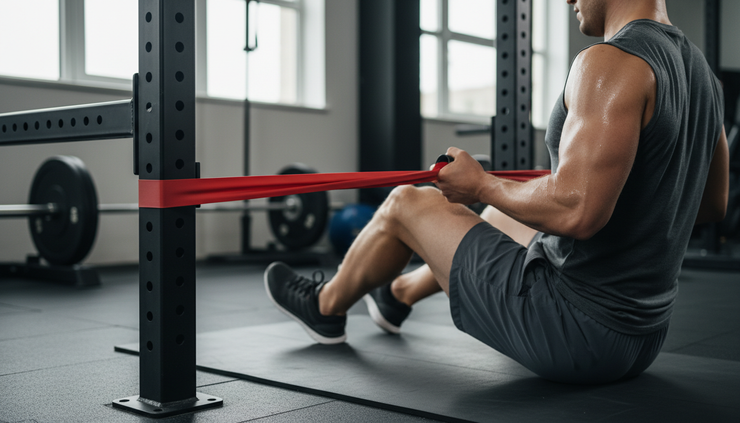
Use machines, cables, bands, and isometrics
Free weights are not mandatory during injury. Machines often reduce balance demands and make it easier to load one muscle group without irritating the injured area.
Isometric training can be especially useful when joint movement is painful. An isometric contraction produces force without visible movement. Examples include wall sits, split squat holds, Spanish squat holds, plank variations, and mid-range pressing holds. Isometrics can maintain strength and may help reduce pain in some tendon conditions when programmed well.
A practical loading framework:
Use pain-free ranges first
Start with moderate effort, around 2 to 4 repetitions in reserve
Use slower tempos when load must stay light
Keep sets challenging enough to matter
Progress only one variable at a time
If heavy loading is unsafe, higher-repetition sets close to fatigue can still stimulate muscle. Research on hypertrophy suggests that muscle growth can occur across a range of loads when sets are performed with sufficient effort, as long as the exercise is appropriate and safe.
Match cardio to the injury instead of removing it
Cardio helps manage energy expenditure, glucose control, mood, and cardiovascular fitness during injury. The right mode depends on the injured tissue.
A runner with Achilles pain may tolerate cycling better than running. A lifter with a hand injury may use a stationary bike, incline walking, or step work if lower limbs are healthy. Someone with a knee injury may tolerate swimming, upper-body ergometry, or deep-water running better than ground impact.
The main variables are:
Impact
Joint range of motion
Load through the injured tissue
Symptom response during and after
Ability to keep technique consistent
Low-impact options often work well:
Option | Best fit | Main caution |
Stationary bike | Many knee, hip, and ankle cases | Seat height and resistance matter |
Swimming | Lower load on joints | Some strokes may irritate shoulders or knees |
Elliptical | Lower impact than running | Still repetitive through hips, knees, ankles |
Incline walking | Useful when running is not tolerated | May irritate Achilles or plantar fascia |
Upper-body ergometer | Lower-body injuries | Can overload shoulders or elbows |
Sled push or pull | Controlled lower-body work | Not suitable for all knee, hip, or back injuries |
For body composition, cardio does not need to be brutal. Moderate-intensity work can help preserve energy expenditure without adding excessive recovery cost.
A simple target is 2 to 5 sessions per week, adjusted to injury type, training history, and total stress. Duration can range from 15 to 45 minutes. Shorter sessions are acceptable if pain, fatigue, or schedule limits capacity.
Adjust calories without starving recovery
When training volume drops, calorie needs usually fall. The error is making the reduction too large.
Energy intake should support tissue repair and preserve lean mass. Severe deficits can reduce training quality, impair sleep, increase hunger, and make protein harder to use effectively. For many injured athletes, maintenance calories or a small deficit works better than aggressive cutting.
A practical method:
Estimate the lost training expenditure.
Reduce calories modestly, often through carbohydrates or fats.
Keep protein high.
Track body weight trend, waist measurement, appetite, and performance.
Adjust every 1 to 2 weeks, not every day.
If body weight rises quickly and waist measurement increases, intake may exceed the new expenditure. If weight drops fast, hunger rises, sleep worsens, and training feels flat, intake may be too low.
Protein becomes more important
Adequate protein helps maintain muscle protein synthesis and limits lean mass loss during inactivity. A widely supported target for active people is roughly 1.6 to 2.2 grams of protein per kilogram of body weight per day, with higher intakes sometimes useful during energy restriction.
Meal distribution also matters. Spreading protein across 3 to 5 meals can stimulate muscle protein synthesis multiple times per day. Each meal should contain a meaningful dose of high-quality protein, often from sources such as lean meat, eggs, dairy, fish, soy, legumes, or protein powders.
Leucine-rich proteins, such as whey, dairy, eggs, meat, fish, and soy, are useful because leucine helps trigger muscle protein synthesis. This does not mean every meal needs a supplement. Food quality and total daily intake remain the foundation.
Do not cut carbohydrates automatically
Carbohydrates support training, glycogen, mood, and sleep for many people. If cardio and lifting volume drop sharply, carbohydrate needs may fall, but removing them too aggressively can reduce training output and increase cravings.
A better approach is to place more carbohydrates around training and reduce portions at meals that are far from activity if total calories need to come down.
Keep fats and micronutrients adequate
Dietary fat supports hormone production, cell membranes, and absorption of fat-soluble vitamins. Very low-fat dieting during injury rarely makes sense.
Micronutrients involved in tissue health include vitamin D, calcium, vitamin C, zinc, copper, and iron. Deficiencies should be corrected, ideally based on clinical assessment. More is not always better. Supplementing high doses without a reason can create problems.
Collagen or gelatin with vitamin C has some evidence for supporting collagen synthesis when timed before loading, especially in tendon and ligament contexts. The evidence is promising but not magic. It works best as part of a complete rehab plan that includes progressive tendon loading.

Manage immobilization and unloading with precision
Immobilization is one of the strongest triggers for muscle loss. If a cast, brace, sling, or boot is required, the priority is to minimize unnecessary unloading while respecting medical instructions.
Questions to ask the clinician:
Which movements are currently restricted?
Is partial weight-bearing allowed?
Can the joint move through any safe range?
Are isometrics allowed?
Can nearby joints be trained?
What signs mean the plan is too aggressive?
For example, a lower-leg boot may limit ankle movement, but hip and knee exercises may still be possible. A sling may limit shoulder motion, but hand, forearm, trunk, and lower-body training may continue.
Even small amounts of safe contraction can help. Passive rest is rarely the only option for weeks at a time, unless the injury or surgery truly requires it.
Use blood flow restriction only when appropriate
Blood flow restriction training uses a cuff or band to partially restrict venous return during low-load exercise. It can produce hypertrophy and strength benefits with lighter loads than traditional resistance training. This makes it attractive during rehab, especially when heavy loading is not yet safe.
That said, it requires caution. Cuff pressure, limb size, medical history, and exercise selection matter. People with vascular disease, clotting disorders, uncontrolled hypertension, certain cardiac conditions, or pregnancy need medical clearance.
When used, blood flow restriction should be supervised or prescribed by someone trained in it. Guessing cuff tightness is not a scientific method.
Track the right variables
Body composition does not change in a perfectly linear way after injury. Inflammation, glycogen loss, fluid shifts, and reduced training volume can alter scale weight quickly.
Use multiple markers:
Morning body weight average across 7 days
Waist measurement once per week
Progress photos under consistent lighting
Training log
Step count or activity minutes
Pain and symptom response
Sleep duration and quality
Appetite and mood
Do not assume all weight loss is fat loss. If a trained lifter stops training hard and eats too little, scale weight may drop because of glycogen, water, and lean mass. That is not the same as improved body composition.
The better aim is stable measurements, stable strength where possible, and no unnecessary fat gain while the injured tissue regains capacity.
Build a modified training week
The best plan depends on the injury, but the structure below illustrates the logic. This example assumes a lower-body injury that limits running and heavy bilateral leg work, while upper-body training remains safe.
Day | Training focus | Body composition purpose |
Monday | Upper-body strength plus core | Maintain muscle and training routine |
Tuesday | Low-impact cardio | Preserve energy expenditure |
Wednesday | Rehab work plus unilateral safe lower-body work | Maintain neural drive and local capacity |
Thursday | Rest or easy mobility | Control fatigue |
Friday | Upper-body hypertrophy | Preserve lean mass |
Saturday | Low-impact cardio plus rehab | Support conditioning |
Sunday | Rest and meal prep | Support adherence |
This is only a template. A shoulder injury would flip the emphasis. A back injury may require far more care with bracing, axial loading, hip hinging, and fatigue management.
The weekly plan should answer three questions:
What tissues need protection?
What qualities can still be trained?
What minimum dose maintains body composition without slowing healing?
Return to full training through graded exposure
The final stage is not simply “pain is gone, resume normal training.” Pain can improve before tissue capacity fully returns. Returning too fast creates a cycle of flare-ups, detraining, and frustration.
Graded exposure means reintroducing load in planned steps.
For resistance training, progress in this order:
Range of motion
Technical control
Volume
Load
Speed
Plyometrics or sport-specific intensity
For running, progress in this order:
Walking tolerance
Walk-run intervals
Easy continuous running
Strides
Hills
Tempo work
Sprinting or competition
A useful rule is to increase only one major stressor at a time. Do not add volume, intensity, frequency, and impact in the same week.

Common mistakes that worsen body composition after injury
Several patterns show up repeatedly.
Stopping all training
Unless medically required, total rest accelerates detraining. Train what is safe.
Eating as if training volume is unchanged
This often leads to fat gain, especially when step count drops.
Reducing calories too aggressively
Severe calorie restriction can reduce recovery resources and increase lean mass loss.
Ignoring sleep
Poor sleep affects appetite regulation, pain sensitivity, recovery, and training quality.
Chasing soreness
Soreness is not proof of effective rehab. The goal is progressive capacity, not punishment.
Returning to sport before rebuilding tolerance
Fitness may return faster than tissue resilience. Conditioning and structural readiness are not identical.
The scientific bottom line
Adjusting training after injury to maintain body composition scientifically means managing three systems at once: the injured tissue, the rest of the body, and energy balance.
The injured area needs protection and graded loading. The uninjured areas need enough resistance training to preserve muscle. Nutrition needs enough protein and total energy to support repair while preventing unnecessary fat gain. Cardio and daily activity should shift to forms the injury can tolerate.
The best plan is conservative where the injury demands it and aggressive where the body can still train safely. That combination protects progress without pretending the injury is irrelevant.
With high regard,
-Coach James
JHenderson Training & Consulting
References
References
Wall, B. T., Dirks, M. L., & van Loon, L. J. C. (2013). Skeletal muscle atrophy during short-term disuse: Implications for age-related sarcopenia. Ageing Research Reviews.
Phillips, S. M., & Van Loon, L. J. C. (2011). Dietary protein for athletes: From requirements to optimum adaptation. Journal of Sports Sciences.
Morton, R. W., Murphy, K. T., McKellar, S. R., et al. (2018). A systematic review, meta-analysis and meta-regression of the effect of protein supplementation on resistance training-induced gains in muscle mass and strength. British Journal of Sports Medicine.
Schoenfeld, B. J., Grgic, J., Ogborn, D., & Krieger, J. W. (2017). Strength and hypertrophy adaptations between low- versus high-load resistance training: A systematic review and meta-analysis. Journal of Strength and Conditioning Research.
Munn, J., Herbert, R. D., & Gandevia, S. C. (2004). Contralateral effects of unilateral resistance training: A meta-analysis. Journal of Applied Physiology.
Slysz, J., Stultz, J., & Burr, J. F. (2016). The efficacy of blood flow restricted exercise: A systematic review and meta-analysis. Journal of Science and Medicine in Sport.
Tipton, K. D. (2015). Nutritional support for exercise-induced injuries. Sports Medicine.
Shaw, G., Lee-Barthel, A., Ross, M. L. R., Wang, B., & Baar, K. (2017). Vitamin C-enriched gelatin supplementation before intermittent activity augments collagen synthesis. The American Journal of Clinical Nutrition.
Järvinen, T. A. H., Järvinen, T. L. N., Kääriäinen, M., Kalimo, H., & Järvinen, M. (2005). Muscle injuries: Biology and treatment. The American Journal of Sports Medicine.
10. Ardern, C. L., Glasgow, P., Schneiders, A., et al. (2016). Consensus statement on return to sport from the First World Congress in Sports Physical Therapy. British Journal of Sports Medicine.


Comments